Fast Forward>>

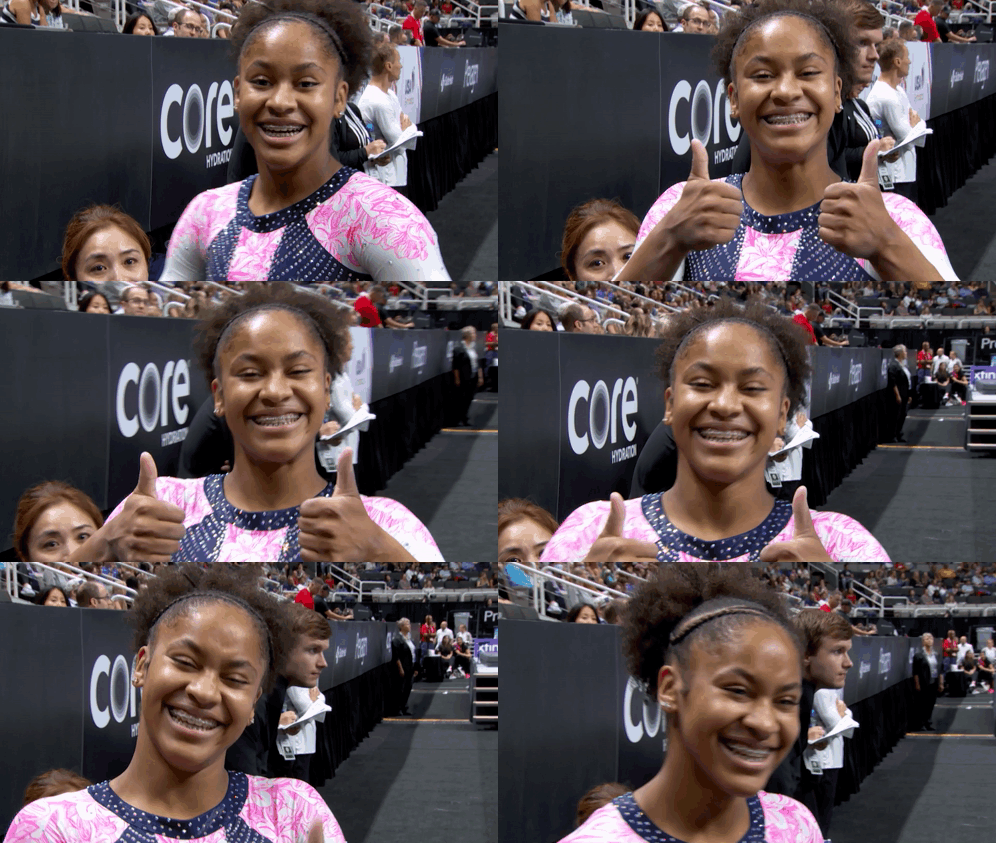
Skye Blakely, achilles tendons, and front tumbling
In the spring of 2024, I had just started coaching gymnastics again after a long hiatus. I managed to convince my new boss to pay for some professional development at USAG’s National Congress — that’s the governing body’s big ol’ three-day annual conference and workshop series. In 2024, Congress just so happened to be in Minneapolis, Minnesota…right down the street from that summer’s Olympic Trials! What a fun ‘coincidence’, right?!
My gymnastics friend Lucy had a gang of people she’d roped into going to Trials with her in the past and they were already planning on going to Minneapolis that year. They graciously let me join their crew and the vibes on the WhatsApp group chat leading up to the trip were ecstatic.
The amount of gymnastics-related information I consumed in the four days I was at Congress and Trials was overwhelming and wonderful. I’d go from tiny room to tiny room in a massive conference center, starting at 8am every day, learning about wrist bracing and how to support seven-year-olds through mental blocks and doing actual dance drills with former Olympian Betty Okino (now the Developmental Lead for the U.S women's artistic program and a personal hero).

In the evening, I would meet up with the gang and watch the US men and women vie for spots on the Olympic Team in a massive arena packed with screaming fans. We made and wore bespoke t-shirts and took a ton of blurry photos and I somehow ended up at a rooftop hotel bar with Nadia Comaneci and Bart Conner and gossiping about Olympic Opening Ceremony drama (...this is a story for another time or maybe never, heh heh).
I look back on that long weekend with a lot of fondness but it was also an intense emotional roller coaster. I was so excited to be there. I was about to see some of my most favorite contemporary elite gymnasts in person — something I haven’t experienced much. Elite American gymnasts don’t actually compete all that often. There are a few big meets: the Winter Cup, U.S. Nationals…and if they’re lucky, a handful of gymnasts will get some international assignments (that I absolutely cannot afford to go to).
But everyone was there in 2024. Shilese Jones, the best bar worker in the country. Suni Lee, the second best bar worker in the country (sorry, I stand by that), who already had Olympic medals to her name but who was making a comeback run while battling an intense and severe kidney disease. Jordan Chiles and Simone Biles!!! And, let me tell you, if you’ve never seen them tumble or vault in person, you’ve been missing out. TV doesn’t do them justice at all.
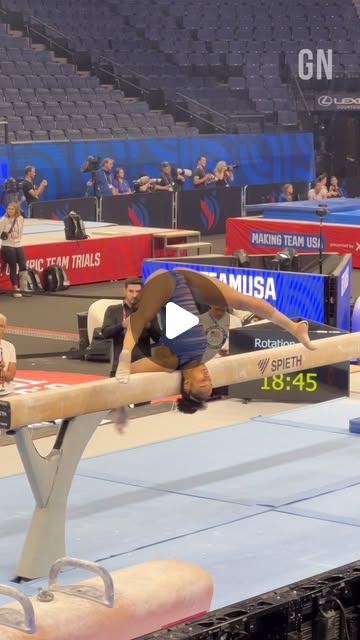
One of the all-arounders (that’s someone who competes on every event) that I was most excited to see was Skye Blakely. She came in second to Simone at Nationals earlier that year. I love watching her do gymnastics. She has explosive vaults and swings through her bar routine like it’s the easiest thing anyone could do. And she seems like she’s having fun. I mean, look at this beam mount.

On June 27, 2024, Lucy and I were heading to the airport to fly to Minneapolis when the news broke that Skye had torn her right achilles during “podium training” earlier that day. She was out of Olympic Trials.
And she wouldn’t be the only one. Over the next three days, we’d watch as Shilese Jones and Kayla DiCello both succumbed to injury (DiCello to another achilles and Jones to a blown out knee). The mood in the arena and on the WhatsApp tangibly shifted. The sound of 67,000 people gasping, then going silent, then cautiously reviving, then gasping again, then going silent — then coming to the conclusion that anyone could go down at any time — it was a wild experience. 1
Two years later, Skye Blakely is back and making her third Olympic run. 2 Since 2024, she fully recovered and competed for the University of Florida. Her elite comeback has been slow and deliberate. She told Scott Bregman for Olympics.com that this year:
“is a foundational year to build back into all-around and doing all my events again…It's not only about how many medals I can win. It's how can I get back and learn and build off what I do this year, so I can be ready for next year, and then 2028."
On the Gymcastic US leaderboard, Skye’s season bests put her in the top three on vault, bars, and beam. This week, Skye went to National Team Selection Camp, to try to earn a spot to go to the World Championships in Rotterdam later in October.
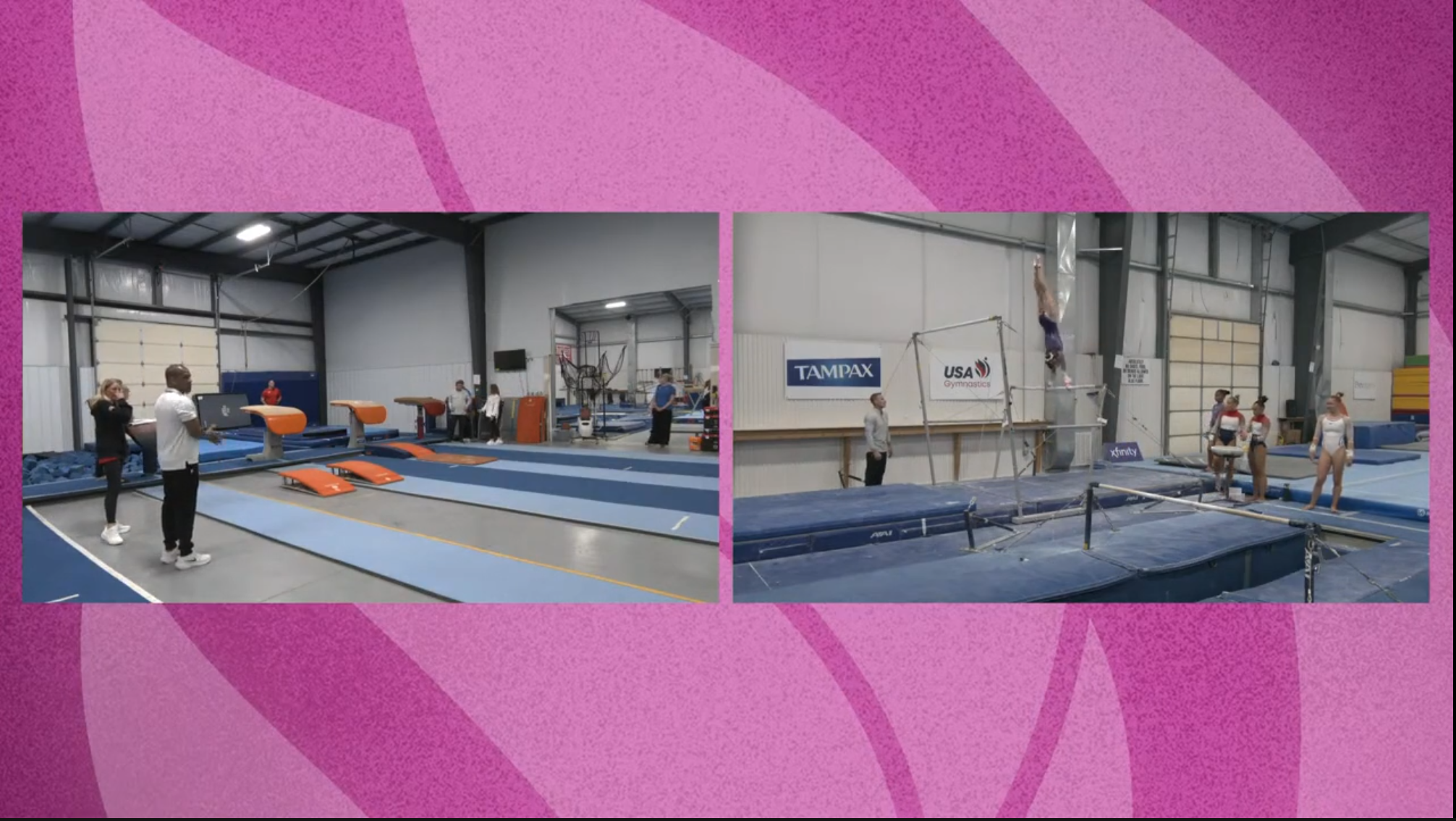
I watched the two days of World Team Selection Camp so that you don’t have to. It’s a split-screen gymnastics meet with no commentary, no public audience, no title cards with athlete names on the screen, and no scores broadcasted. How fun is that?? USAG: classically known for their excellent marketing (...not). The background of the live stream is pink with big old tampon ads, so at least you know this is LADY GYMNASTICS.
Anyway, back to Skye Blakely. In her interview with Bregman, Skye addressed the fact that she tore her achilles on floor in 2024, but that floor is where she ‘most wants to be’:
"I really love dancing, and for it to be the event I got hurt on, I just want to get back on it and show myself that it's OK and I'm still capable of doing it…I am not afraid of it at all."
Skye trains and travels with her Florida coaches to elite meets now and her elite floor routine is a modified version of her college routine. Notably, she doesn't do the skill she got hurt doing, a double back flip in a laid-out position:
Trinity Thomas doing a roundoff back handspring double layout in 2022. She's the best to EVER do this skill.
In fact, Skye doesn’t really go backwards much at all. But that’s out of practicality, not fear. Skye composed her floor routine to protect her achilles by taking off backward as little as possible3 while still meeting the requirements of the Code of Points (more on the mechanics of that below).
However, it’s not like she’s got an easy routine. There’s a little bit of a twisted logic to it, but you could argue that backwards tumbling is harder — and therefore, routines that have back tumbling are easier to construct. That’s because there are difficulty requirements for each routine and in order to maximize your score, you want to maximize difficulty (and maximize how beautifully those difficult skills are executed, sure, but let’s just focus on one thing at a time, here). If you can safely tumble backwards or are willing to take a greater risk, you could theoretically end up with a greater reward, delivered more easily.
The double layout is a great example of this. In the Clickable Code of Points, Spencer from the Balance Beam Situation writes:
“The double layout is an exceptionally common skill in elite floor routines, largely because its F (0.6) value provides a lot of bang for the effort—especially compared to skills in the twisting or double Arabian realms, where some of the most difficult possible options are F. The double layout, by contrast, is a link-in-the-chain skill where proficiency with the DLO can lead to adding twists and upgrading to increasingly valuable skills, all of which can be put in the same routine to rack up the difficulty score.”
Unlike that back tumbling scenario, where one skill gets athletes the high difficulty score they need, Skye’s current approach is to piece together forward-moving skills in combinations that give her bonus points. Her second tumbling pass is a good example:
This is a: front handspring + double front salto (E) + stag jump (A)
That double front flip is really hard, but when she adds the jump out of it, she theoretically gets a "connection bonus" of +0.10 to add to her base difficulty score (direct connection of an E-rated salto to a dance element). At a very basic level, the writers of the Code of Points seem to think that multiple skills in combination is probably harder or at least as hard as doing one hard skill alone. That means that Skye's second tumbling pass is worth a total of 0.60 (0.50 for the double front and +0.10 bonus for the jump connection), bringing her difficulty in line with the ol' double lay of floor routines past. (Sorry for the surprise math!)
Quick sidebar: if I were on the selection committee, I’d be a little concerned about the quality of the connection between her double front and her stag jump. She didn't get the height on that jump that she could be getting on day one of Worlds Selection Camp — especially when you compare it to her gorgeous dance later in the routine:
Time to get some audience participation in! If you can jump safely, try this: squat at your knees and push off of the floor into the air. Feel that? Ok. Now put your ankles together and bounce on the balls of your feet. Don’t bend your knees, but definitely do squeeze your butt cheeks together while you bounce.
The first feeling is more like what Skye does between her double front and her stag jump. That second feeling is more like the plyometric feeling you want to have between tumbling skills. If Skye wants to make that connection bonus undeniable and justify not tumbling backwards, she’s going to need to make the “punch” between her double front landing and her stag jump more explosive. IMHO.
(OK, we're back.) Yesterday, Skye made the US team for the 2026 World Championships! 4 While they probably won't rely on her for a super high floor score, her front tumbling plan makes her a solid all-arounder. And seems to be working to reduce her chances of injury.
A 2021 study (specifically of collegiate gymnasts) found that “most [achilles] ruptures (91%) occurred on floor exercise; 85.7% of these occurred during back tumbling-take-off.” Tumbling landings absolutely pack a wallop on your whole body (some people compare the force of a huge tumbling pass to the force of jumping out the window of a multi-story building). But take-offs come with force and propulsion.
For backwards take-offs, that happens with the legs in a very particular position to maximize the height of the next skill. The study found that most achilles injuries happened between a back handspring and a flip. Unless you’re prepping to go into another back handspring, you don’t want to land standing straight up. You want to be really stretched out with your feet behind your hips — which closes the angle of your ankles and elongates your calves. That’s going to help give you a big lift into your next flip. And that’s where a potentially over-used achilles can stretch to its snapping point. 5 That ankle bend and calf stretch — that doesn't happen in front tumbling take-offs. Hence, Skye's change in routine composition.
Unfortunately, there are a ton of factors that contribute to achilles tears in gymnastics (and a ton of achilles tears to launch research studies from). It's not just back tumbling that will do it. You've got the "jumping and loading" demands of the sport, on every event. A study in 2020 found that NCAA gymnasts reported a higher number of achilles tears than other NCAA athletes.
"Specifically, the rate of all Achilles injuries (ie, complete and partial Achilles tendon tears/ruptures) in women’s gymnastics was 4-fold greater than in men’s basketball, which held the second-highest reported injury rate per 100,000 athlete exposures." 6
And that 2021 study of collegiate gymnasts found that women who trained elite before competing in college are at a higher risk for achilles tears (Skye). So are all-around college competitors (Skye). So are Black gymnasts (Skye). Also at risk? Athletes who have torn an achilles before (Skye, now, unfortunately).
There’s one potentially more controllable factor to talk about when it comes to tumbling and achilles tears: the floor itself. Women performing artistic gymnastics in a squared-off area goes back almost a century. In 1936, women did group exercises at the Olympics with “portable apparatus” — think calisthenics with a pair of clubs — and piano or gramophone accompaniment. 7 There wasn’t a mat to speak of, just a wooden plank covered in cork. By the early and mid 1950s, women got to compete individual routines on carpets. No music, yet (that didn’t come until 1958), but there were more recognizable acrobatic skills:
Larissa Latynina in 1956 — yep, that's a back handspring.
Some carpeted floors were hardwood underneath, some had mats filled with horsehair. According to gymnastics-history.com, the 1979 World Championships is commonly believed to be the first time a spring floor with coiled springs was used at a major event hosted by the International Gymnastics Federation (FIG, now called “World Gymnastics”).
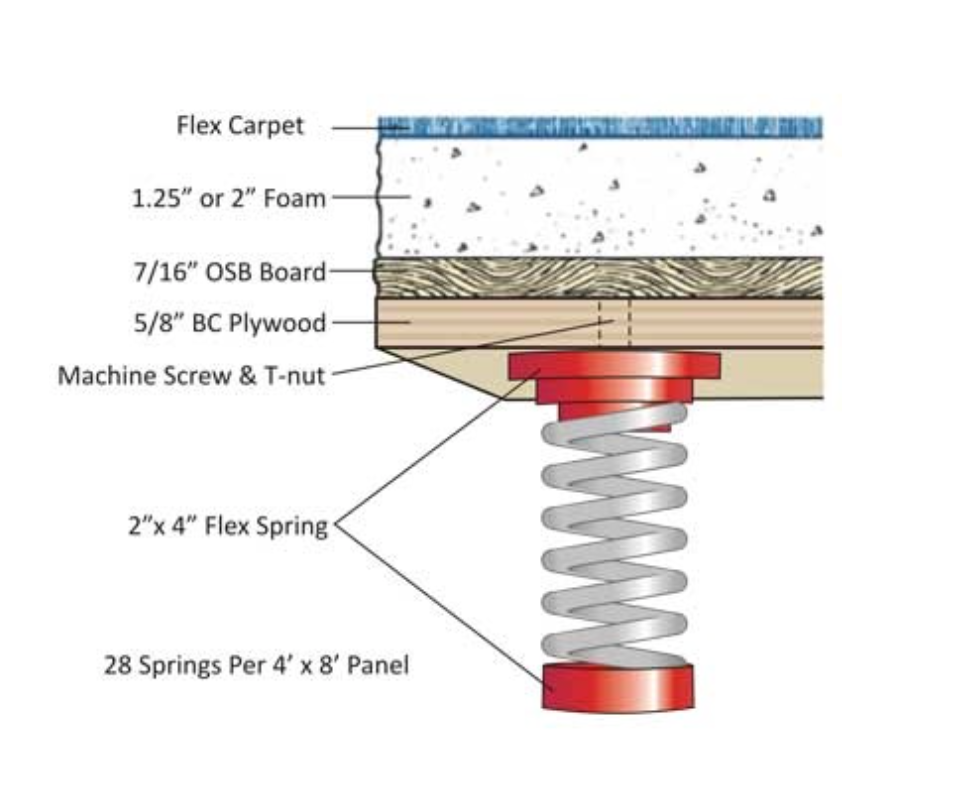
Today’s floors are a whole system that consist of a subfloor (some kind of concrete or rigid platform), steel springs spaced 30-50cm apart, 12-20cm thick foam padding, moisture-sealed and warp-resistant birch or maple plywood decks, and carpet-bonded foam for the top:
While early floors gave gymnasts less than 50% of their energy back on a jump or tumbling rebound, these new spring floors allowed for 85-90% “rebound efficiency.” That’s why you get articles with headlines and commentary like, “Simone isn’t that special, there are springs in the floor that make her tumble that high.” (Lies. She is incredibly special.)
All this floor specification talk seems scientific and thought through — and there are definitely rules about floor materials that gyms and competition venues have to follow. 8 Weirdly, those rules have no mention of springs at all, just a requirement for “elasticity.” That means that not all floors are created equal. Some have more springs, others have more foam. At major competitions, floors get placed atop podiums — raised stages, usually with aluminum frames — that can sometimes make them even more bouncy. 9
The reason why the lack of floor consistency matters is because gymnasts typically train on softer, older floors. Competition venues wheel out the new, fancy, and harder floors for big meets. That means that the springs haven’t been depressed as often as the ones in your home gym, maybe. Or the foam is stiff because it hasn’t been tumbled on before.
In 2024, two researchers found that gymnasts who train on bouncy floors but compete on stiffer floors are 23 times more likely to rupture their achilles at meets “due to the positioning of their ankles:”
“Competition floors tend to be newer and stiffer than training floors, which affects how athletes land on their feet. On a softer practice floor, the gymnasts’ toes dig into the floor upon landing. There is less dorsiflexion in the ankles, which creates a larger angle between the foot and the shin. On a stiffer or harder floor, the toes are not able to grasp the floor as much, which creates more dorsiflexion and a smaller angle.”
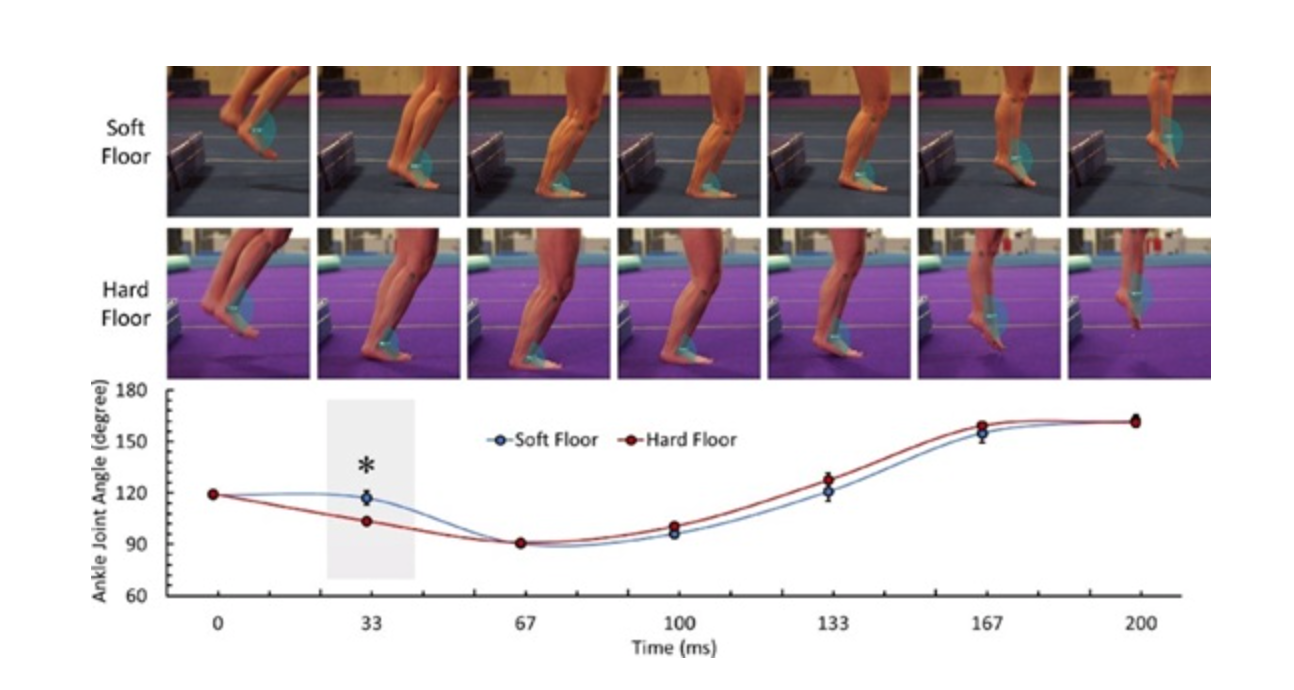
This is a classic scenario — and it’s part of why NCAA gymnasts rupture their achilles in competitions or elite gymnasts go down in podium training. The researchers say that those athletes probably have a decade of microtrauma in their achilles’, weakening them. They go to do a roundoff backhandspring double layout, their ankles bend too much and their achilles overstretch, compensating for a stiffer floor than they’re used to. They feel that classic ‘pop’. They’re out for six months to a year.
Predictably, the researchers of that study call for stricter norms in floor manufacturing, with a one-size-fits-all standard of elasticity. What was surprising to me, though, was that they think gymnasts should train on harder floors:
“If gymnasts would train on newer (stiffer) floors, their musculoskeletal systems [could] adapt to these conditions and [would] not suddenly experience greater Achilles tendon strain during competition on stiffer floors,” co-author Emily Muhlenhaupt said.
I guess if stiff floors are expected to be the competition norm, you don’t want your achilles to be shocked by that. But it seems like it would be easier for FIG or the NCAA to require a softer floor at competitions, rather than put the onus on thousands of gyms across the world to get harder floors. I’m no biomechanical or physiological expert, though. I’m just a girl who wants all gymnasts to have two working achilles by the time they’re 21. And who will absolutely be in the stands for the US Olympic Trials10 in Louisville, Kentucky in June of 2028 — cheering so loudly for Skye Blakely.
1 Of course, of course, of course: it’s worse for both the injured athletes and the gymnasts that are meant to compete next! But even as spectator, it felt like being invited to a party and then realizing that party was three wakes in a row.
2 Paris 2024 was actually Skye's second attempt. Her first was Tokyo. When the 2020 Olympics were moved to 2021, she suddenly found herself age-eligible. She made Olympic Trials but got injured during vault warmups, needed elbow surgery, and was out of the running.
As of October 2026, we know that Shilese Jones is recovered and throwing skills around in the gym. Kayla DiCello is currently recovering from a different surgery. (What is this sport?!?)
3 Skye's first tumbling pass is the only one with a brief period of traveling backwards: she does a roundoff back layout with a 1.5 twist, which allows her to change direction and move forward again.
4 I believe you'll be able to watch those for free on Eurovision Sport! (Perhaps with a handy VPN.)
5 "Gymnasts who have competed for 10 years or more have a higher risk of developing Achilles tendon ruptures due to repeated microtrauma to the tendon, which weakens it. One of the causes of microtrauma in the Achilles tendon is overstretching. Overstretching can happen when the angle between the foot and the shin becomes too small during dorsiflexion (imagine pointing the toes up toward the sky)." https://www.physiology.org/detail/news/2024/04/05/gymnasts-injury-risk-increases-on-stiffer-competition-floors?SSO=Y
6 Chan JJ, Chen KK, Sarker S, Hasija R, Huang HH, Guzman JZ, Vulcano E. Epidemiology of Achilles tendon injuries in collegiate level athletes in the United States. Int Orthop. 2020 Mar;44(3):585-594. doi: 10.1007/s00264-019-04471-2. Epub 2020 Jan 6. PMID: 31907586.
7 "Piano players (accompanists) or grammophone records, etc. must be furnished by the different nations.” https://www.gymnastics-history.com/2022/04/1928-1956-the-apparatus-of-womens-gymnastics/ This was true then and is still, in some ways, true now. I had to bring a cassette tape with my floor music to competitions in the 90s. Today's coaches have .mp3s of their athletes' floor music loaded on their phones and the technical staff at meets has every phone jack imaginable to plug them in.
8 If you’re feeling especially nerdy, the FIG makes its "apparatus norms” public — the specs for women’s floor is on p. 65.
9 Bouncy springs could, theoretically, make you fly higher — which would be nice except that if a competition floor on a podium is bouncier than the floor you’ve trained on for a whole season, your sense of timing and air awareness (proprioception) can get completely thrown off. That can result in something as minor as an out-of-bounds deduction (and a commentator saying you “just have too much power”) or something as serious as getting the infamous “twisties” and crashing onto your head.
10 If you become a gym fan by then, I'd highly recommend going. You're not getting tickets to the Olympics, sorry. This is the next best thing and I truly mean it when I say: you haven't seen anything until you've seen gymnastics live and in person.