Derailing the Stick Train
Sticking the landing isn’t contagious, no matter how many times you say it is.


If you’ve seen Olympic gymnastics on TV in this century, you’ve probably let Tim Daggett into your living room without even knowing it. He’s a former college gymnast (UCLA) and an Olympic medalist (in 1984, he won bronze on pommels and gold with the men’s team). He’s also a long-time commentator for NBC, known for this exciting catch phrase: “That’s Gymnastics 101! Fly high and stick the landing!”
Tim’s not wrong, even if his catch phrase has become a little cringey over the last 34 years1. Jumping or leaping or vaulting or flying off something and landing on your feet is kind of the whole point of gymnastics, no matter how many flips you do to get there. Recreational, team, and elite coaches spend a ton of time teaching gymnasts to finish their skills and plant their feet without moving — to “stick” — and to stick safely.

Sticking landings in women’s gymnastics means fewer possible deductions from an overall score. In American men’s gymnastics, sticking a dismount means you get a .1 bonus added to your score (lucky ducks). A stick is also often the last thing judges and audiences see — a chance to salute with purpose (and maybe a little attitude). Especially when it happens on vault! Imagine you just sped down the runway at like 15 mph - flung yourself in the air towards a stationary object - repelled off of it into a series of flips and twists - did your absolute best to figure out where the floor was in relation to your face…and then froze, as former gymnast and commentator John Roethlisberger would say, “LiKE a TOOThpicK in A CLUB sandWICH!!!” It’s pretty impressive.
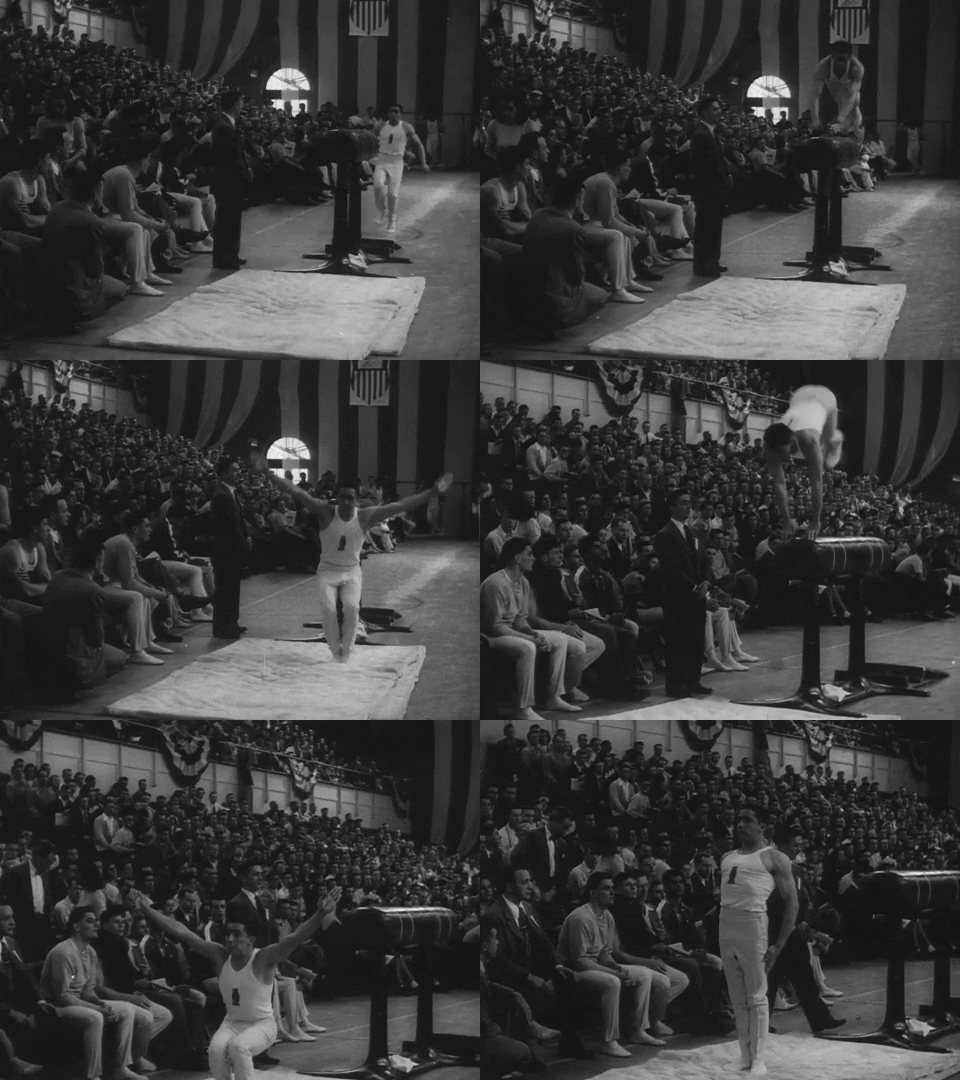
Stuck landings have become both commonplace and wildly celebrated in women’s college gymnastics, in particular. It’s partially because, as people have argued elsewhere2, women’s college gymnastics routines have become…kind of boring. We see the same Yurchenko vault entry and a one and a half twist over and over and over. On beam, we get the same dismount over and over again (a gainer full, easy peasy). Even bar routines are constructed in the same way, with the same release moves (if it ain’t a Pak, don’t fix it I guess?). The only thing that really differentiates these routines for the judges and for the audience is whether someone sticks their landing or not.
I was watching college gym with my friend Lucy a few years ago and one thing those commentators kept repeating was the notion that “sticks are contagious.” If one gymnast sticks, her teammates seem likely to stick, too. Commentators started referring to “the stick train.” As in, “let’s see if the first gymnast up on this event can get the ‘stick train’ going for her team.” They repeat the idea that one person’s stick can lead to another person’s stick so often that it became an inside joke between me and Lucy. Going to ACC Championships this year? Bring a mask — you know those sticks are contagious.
Last year, the NCAA gymnastics commentary was absolutely ridiculous. Only five weeks into the 2025-2026 season, we had already heard some variation on “stick contagion” more than a dozen times...and even heard it twice in one meet, during three separate meets. That’s not contagion, that’s an epidemic.
There are so many gymnastics commentary clichés: “she went lights out,” “just a small hop,” “the judges are really looking for that handstand position…” But to me and Lucy, “stick contagion” seemed uniquely measurable. Quantifiable. And maybe...disprovable? So we watched a TON of college meets from across the previous 2024-2025 season. We counted sticks on bars, vault, and beam3. We noted both team and individual average scores on those respective events and even considered the skill leading to the stick (or not stick). We fed all of our data into open source statistical computing software and learned some interesting facts.
First and most importantly (but maybe not surprisingly): sticks are not contagious. In fact, any number of prior sticks don’t meaningfully predict the likelihood of another stick. When two or three people stick in a row, we can’t say with confidence that it’s because the previous person stuck. It could just be random chance.
By itself, this fact could seem like a let down. It’s fun for fans to believe that sticks are contagious. It might even be psychologically important for gymnasts to believe that, since stuck landings are confidence boosts to individuals and teams. So why ruin it? Because I’m a journalist and I love facts and I hate fun.

Actually, it’s because I think it’s important for gymnasts, coaches, and fans to understand how sticks come to be — and it ain’t through magic or good luck.
To dig into this, I called up Kathy Johnson Clarke. In 1978, Kathy won bronze at World Championships on floor. In 1984, she helped the US women win a team silver medal at the Olympics and took home an individual bronze medal on beam, too. She started calling NCCA meets for CBS in 1983 and elite competitions for NBC and TBS in the late 80s. Kathy only recently retired from commentating for ABC and ESPN.
It was a little awkward to call a famous commentator and be like, “WHY do commentators say this nonsense??” but Kathy was a dream to talk to. Right out of the gate, she hit me with this gem: “Sticks aren’t contagious. Clichés are contagious.”
According to Kathy, this theory about sticks arises from pure excitement. Commentators are feeding off the energy of a team, a coach, a crowd — and then two or three or five people stick their landings in a row and you just can’t help it! It seems magical!! So you call it that way.
Behind the scenes, says Kathy, everyone knows that sticks aren’t contagious. But the goal is to try to make them appear contagious — to make as many sticks as possible as consistently as possible. To do that, gymnasts need to do more than just glue their feet to the mat when they land. Stuck landings actually start in the air, with sufficient amplitude, awareness of one’s body in space, and the ability to see the floor and anticipate the moment of impact. Every single aspect of that can be drilled — or, broken down into its component parts and practiced in a safe, low-impact way:
“That is what is contagious. The drills. When you can trust your training and trust your drills, you’re going to come up with sticks and it will quote unquote become contagious.”
To illustrate all of this, Kathy wants us to think about the University of Oklahoma and their stellar vault rotations. Oklahoma has won eight national titles. They’ve made the team final 12 times in the last 13 years. They’ve got elites on the team and Olympic hopefuls on the way. Full disclosure: they are not my favorite team to watch, but they get it done. And their vaults are sticky as hell.
In her last few years as a commentator, Kathy says she kept hounding the ABC/ESPN camera operators to take B-roll of Oklahoma’s vault warmups: “I really wanted us to show how Oklahoma warmed up on vault because they had the key in how to get the proper shape and rise off the table to enable a stick.”
ABC/ESPN maybe didn’t find this as interesting as me and Lucy and Kathy do — I can only remember one time when they showed an Oklahoma vault warmup and I can’t remember which meet or season it was. Luckily for us, Oklahoma’s Associate Head Coach Lou Ball was featured on an Planet of Gymnastics Instagram reel back in March discussing their process:
How do I apply for the job of Oklahoma Vault Timer Mat Holder #4?
Notice during those “uphill” drills, says Kathy, “They’re above the level of the table with their feet pointed straight down. Then you begin the layout one and a half twist or double or whatever vault you’re doing. So that was step one that I saw. [I thought] ‘Oh boy, if this catches on’…”
It seems like it did catch on, if the current Oklahoma coaches actually borrowed the drill from Nebraska…while they were still coaching at Iowa State. (The contagion at least spread through the midwest!)
On the one hand, it’s cool that drills that work so well for one team can work for other teams — obviously, I don’t want coaches to gate keep their secrets. That would, theoretically, just keep the same teams winning over and over and there’s no real Sports Fun in that. On the other hand: if sticking the landing is becoming commonplace, predictable, and cliché…maybe changes to the rules that incentivize unique and harder-to-stick skills would keep things spicy.
I’m thinking specifically about beam dismounts. In our research, Lucy and I found that almost 80% of people who performed a gainer full off the side of the beam stuck it.

Gainers can be exciting for people who don’t know they’re coming (my partner still gasps every time it happens, thinking someone’s about to smash their whole body and soul into the beam). But an 80% hit rate is boring for a sport that thrives on chaos and wants to hook more viewers. I think the code of points for college gymnastics4 could use a shake up.
But! …that’s for another newsletter.
.2 Bonus
For a slightly unhinged version of this newsletter, check out this short audio piece. It features parts of my interview with Kathy Johnson Clarke and clip montages of “stick contagion” mentions so you can really feel the cliché:
To hear Spencer from Gymcastic read the letter me and Lucy wrote to the show after we did the research, check out this episode.
Tim started commentating during the 1992 Olympic Games. ↩
Long-time Gymcastic listeners know that this is a frequent complaint. It’s common over on Reddit, too. ↩
Why didn’t we count sticks on floor? Because on floor, you aren’t required to stick your landings without stepping. In college gym, you’re allowed to take a controlled step to “lunge” out of your landing in the direction of travel without incurring a deduction. Counting whether a lunge is controlled or not is up to the judges’ discretion, so including floor landings would’ve made our data weird. ↩
The Code of Points is basically a rule book for both gymnasts and judges. It helps gymnasts build their routines by telling them how many points their skills are ‘worth.’ It helps the judges by telling them how many points they should take away from a gymnast for failure to show a complete routine or for any execution errors. Bars, beam, and floor routines all start with a base score of a 9.4 — you build up your ‘start value’ to a 10.0 by fulfilling special requirements, doing difficult skills, and connecting skills to one another. (Vault works differently, of course. Couldn’t keep it simple.) The rules for all of these things are slightly modified from the Level 10 code of points, but it would be a pretty big stretch to say that college gymnastics has its "own" set of rules. **Extremely Owen Wilson voice: What this newsletter (and many other experts) presupposes is, maybe it should? ↩